
Explore publications and materials from the TRR 402
Learn more through scientific publications, posters, presentations, and open-access papers and gain insights into current research results and developments within the collaborative research center.
Categories
Release Date
24.09.2026
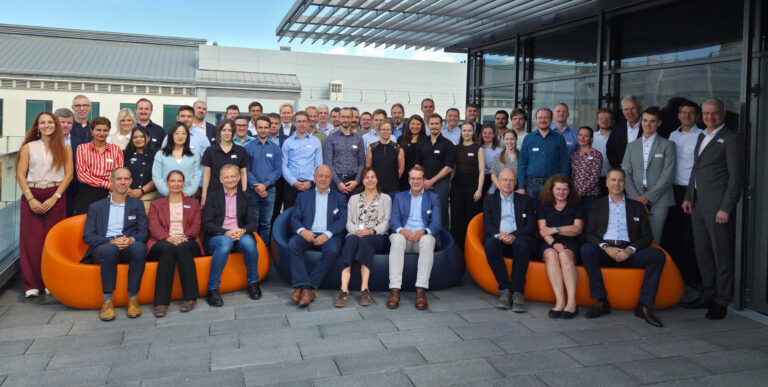
The fourth General Meeting of TRR 402 took place in Vienna on 14 and 15 September 2026 at the Institute of Lightweight Design and Structural Biomechanics of TU Wien.
On Monday afternoon, the working group workshops focusing on simulation, characterization, and the iDP system provided an opportunity for intensive discussions and focused exchanges within the smaller groups.
On Tuesday, the progress of the individual subprojects was presented and discussed in a plenary session. In addition, the first step towards preparing for the second project phase was taken. Each subproject was asked to present an idea for how its research could be further developed based on the results achieved so far. The proposed research objectives as well as the steps and methods required to achieve them were discussed in detail.
These ideas were subsequently discussed in depth by the project leaders in the three project areas A, B, and C. It was particularly encouraging to see the professors and postdocs engage in intensive discussions about our current research and the future direction of TRR 402.
TU Wien provided an excellent setting for the meeting. The project members were hosted in a rooftop conference room with spacious terraces, offering a pleasant environment for informal discussions and exchange over coffee in the sunshine.
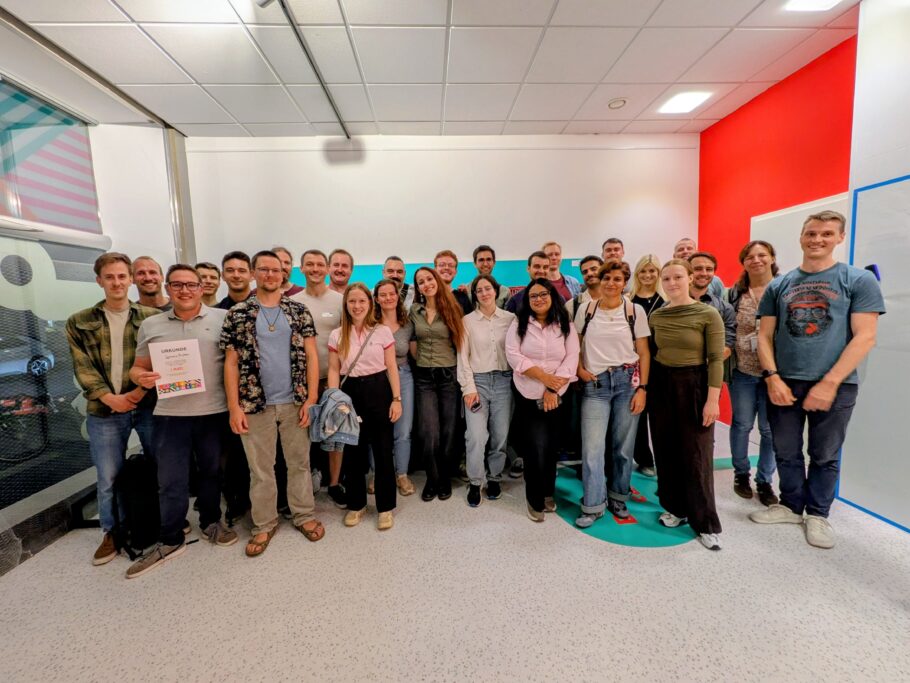
What makes a bridge design perform well? And how can topology optimization help to improve its mechanical performance? These questions were at the heart of a two-day summer school on topology optimization held on September 16 and 17, 2026. Bringing together all PhD students of the research program, the summer school combined theoretical foundations, hands-on design, additive manufacturing, and experimental testing.
The summer school was hosted by TU Vienna and opened with an introductory lecture by Prof. Stefanie Elgeti, who provided an overview of fundamental concepts and current approaches in topology optimization. The central challenge was simple to state but demanding to solve: each team had to optimize the design of a bridge that is then additivly manufactured for subsequent mechanical testing. The participants learned how to identify relevant boundary conditions, define suitable optimization objectives, and translate the resulting designs into physical components. Following the design phase, the bridges were 3D-printed and prepared for testing.
The results were put to the test on the second day. In total, 13 topology-optimized bridges and one non-optimized reference bridge went head-to-head in a mechanical test. The objective was to determine which design achieved the highest specific stiffness. The direct comparison provided an engaging way to experience the influence of topology optimization on the mechanical performance of lightweight structures.
The technical program was complemented by two guest lectures addressing aspects of sustainability and materials. A contribution from the REPOXYBLE project at BOKU Vienna provided insights into the development of recyclable epoxy resin systems. Prof. Vasiliki-Maria Archodoulaki from TU Wien discussed the challenges associated with recycling packaging waste. Together, the lectures broadened the perspective beyond topology optimization and highlighted the importance of considering material sustainability and end-of-life aspects in engineering design. Further insights from industrial practice were provided by Wolfgang Pelzer from M.Tec Engineering. In addition to the technical program, the summer school offered ample opportunities for informal exchange and networking. A team event followed by a joint dinner rounded off the first day.
The summer school concluded with a joint discussion and feedback session. By combining theoretical input, hands-on design, additive manufacturing, and experimental testing, the event gave the PhD students the opportunity to experience the complete path from an optimization problem to a physically tested component and to discuss how topology optimization can contribute to the development of lightweight and resource-efficient structures.
Learn more through scientific publications, posters, presentations, and open-access papers and gain insights into current research results and developments within the collaborative research center.
Do you have questions about the TRR 402 or are you interested in collaboration? Feel free to contact us – we are happy to hear from you and will gladly respond to your inquiry.